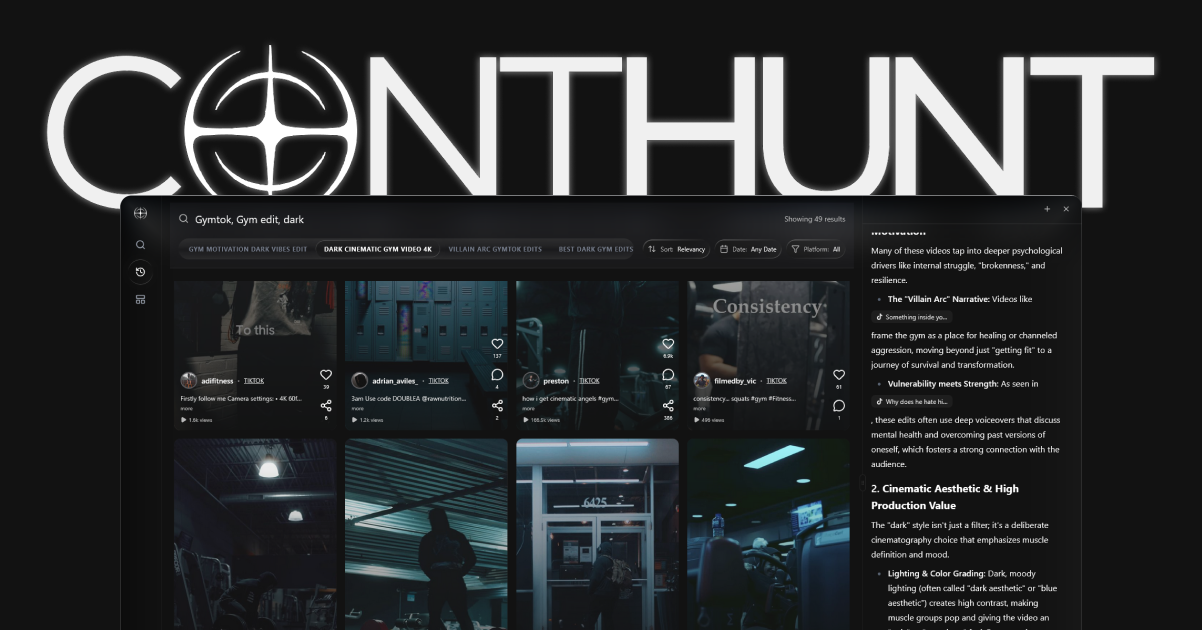
How to Find Winning Short-Form Content in 2026

How to Find Winning Short-Form Content in 2026

Winning content is not an accident—it’s a Data Point. In 2026, the global feed is a high-speed laboratory where millions of ideas are tested every hour. Your goal is to be the “Algorithmic Spy” who identifies the successful experiments and brings the findings back to your own channel.

1. The “Relative Outperformer” Metric

The holy grail of 2026 discovery.

  • The Logic: A creator with 1M subscribers getting 100k views is “Normal.” A creator with 100 subscribers getting 100k views is a “Global Winner.”
  • The Action: Use ContHunt to filter your niche for ‘Outperformers.’ These videos contain a “Secret Sauce” (Hook, Audio, or Topic) that the algorithm is rewarding despite the creator’s small size.
  • Execution: Bridge that winner to your audience immediately.

2. Cross-Platform “Node Migration”

Identify trends before they switch apps.

  • The Workflow: Find a high-velocity interest node on TikTok that hasn’t yet dominated YouTube Shorts.
  • The Move: Translate that visual style or topic into the YouTube Shorts format.
  • Result: You arrive at the “New Platform” as the Node Authority, capturing the massive discovery potential before the ‘Wave’ of other creators arrives.

For the execution layer after discovery, use Short-Form Video Best Practices 2026 to adapt hooks, captions, hashtags, and retention checks across TikTok, Reels, and Shorts.

3. The “Information Gap” Reconnaissance

Find what’s missing, not what’s there.

  • The Strategy: Analyze the top 10 ‘Winning’ videos in your niche.
  • The Tooling: 2026 AI sentiment analysis in ContHunt identifies the most frequent questions left unanswered in the comments.
  • The Idea: “Every viral video about [Topic] missed this one step.”
  • Outcome: You create a ‘Winner’ by improving upon an existing ‘Winner.’

4. Top 10 Recon Triggers for 2026 (via ContHunt)

  1. The 3-Second Retention Peak: Videos that lose 0% of their audience in the first 3 seconds.
  2. Audio-Share Ratio: Tracks where the audio is being ‘Remixed’ at a high rate.
  3. Sentiment Polarity: Identifying topics that are causing ‘High-Engagement Debates.’
  4. Visual Signature Velocity: Tracking the rise of a new editing style (e.g., #hyper-real-ai).
  5. Node Overlap Breakouts: When two unrelated nodes (#coding and #gardening) suddenly overlap.
  6. Global Search Spikes: Real-time data of what users are typing into the 2026 search bars.
  7. Verified Expert Alignment: When high-authority accounts all start covering a new topic.
  8. Low-Competition Clusters: Nodes with high view counts but very few ‘High-Quality’ creators.
  9. Audio-Visual Synergy: Videos where the beat-drops align perfectly with visual transitions.
  10. The “Silent Winner”: High-retention videos with zero voiceover (Minimalist Nodes).

2026 Reconnaissance Checklist

  • [ ] Have I identified the top 5 ‘Outperformers’ in my niche this week?
  • [ ] Am I tracking ‘Node Migration’ from TikTok/Instagram to YouTube?
  • [ ] Have I found the ‘Information Gap’ in the current viral winners?
  • [ ] Is the node velocity for my chosen winner still in its ‘Expansion Phase’?

Conclusion

The 2026 creator is a Data Scout. By spending more time on reconnaissance and less time on guessing, you ensure that every video you produce is standing on the shoulders of proven winners. Use ContHunt to master your algorithmic recon, and never film a flop again. Find the win.

How should you apply How to Find Winning Short-Form Content in 2026 without copying one viral post?

Start with a small sample of public posts in the same niche and format, then compare them side by side. ContHunt is useful here because it keeps the original source available, so you can inspect the first seconds, overlays, comments, and publishing context instead of ranking ideas by total views alone. Capture the promise, the proof, and the next step the creator asks for. After you draft your version, change only one variable at a time: hook, length, caption, or thumbnail. That is the founder-led research loop we use internally at Synthenova Enterprises LLP: evidence first, then a test you can actually measure.

What should you write down while reviewing examples?

    1. The “Relative Outperformer” Metric
    1. Cross-Platform “Node Migration”
    1. The “Information Gap” Reconnaissance
    1. Top 10 Recon Triggers for 2026 (via ContHunt)
  • 2026 Reconnaissance Checklist
  • Conclusion
  • Original URL and publish date
  • Audience and offer, if one is stated
  • What you will test next on your own account

Which ContHunt workflow matches this page?

  1. Search public short-form videos for the same viewer problem.
  2. Open several examples and keep the source links.
  3. Compare hooks, pacing, text, and comments.
  4. Turn repeating patterns into a brief, not a clone.
  5. Validate with your own retention and reply data.

Which official docs should you verify against?

How do you keep the brief honest?

Write the date you collected examples and the number of posts you actually opened. If you only watched two videos, do not describe a trend. Note what you could not see: private analytics, paid spend, and anything behind a login. ContHunt does not replace YouTube Analytics, Instagram Insights, or TikTok Analytics on your own account. It helps you inspect public creative with the source still attached. When you publish, keep a short log: hook used, length, caption, and the result after a comparable window. That log is more useful than copying a competitor’s posting time.

If the page you are briefing is about How to Find Winning Short-Form Content in 2026, ask whether the viewer already knows the punchline. If they do, the first seconds have to show a new proof, a tighter demo, or a clearer next step. If they do not, the first seconds have to name the problem in plain language. Either way, the caption should match the video so a muted viewer and a later reader get the same promise. That is the standard we use in editorial review at ContHunt, and it is the standard we recommend to agencies handing briefs between researchers and editors.

What questions should you answer before you shoot?

Does this idea match the audience you can actually reach? Can you film the proof you described? Is there a next step that is honest? If the answer is no, pick a smaller version of the idea. Then review two more public examples and only then schedule production.

Related research

Key data

Early Detection
48 hours — The average head-start ContHunt users get over the 'Global Feed' when identifying winning content nodes in 2026.
Viral Probability
3x Higher — The increase in success rate for creators who model their content on 'Fast-Velocity' winners identified via data recon.

Common Questions

How do I know if a video is 'Winning' in 2026?
Look at the **'RPI' (Relative Performance Index)** in ContHunt. If a video is outperforming its creator's channel average by 5x or more, it is a winning concept that the algorithm is actively testing.
Is it better to find winners on TikTok or YouTube Shorts in 2026?
Both. In 2026, trends often start on TikTok but find their highest-monetized longevity on YouTube Shorts. ContHunt provides a 'Cross-Platform Velocity' view to show you where a trend is moving next.
Can I find winning content without expensive tools in 2026?
Yes, via the **'Search & Sort'** manual method. Search a high-velocity hashtag and filter by 'Last 24 Hours'. The videos with the most likes relative to their posting time are your winners.
All posts
Alex

Written by

Alex is a content creator with 500K+ followers across TikTok and YouTube. He breaks down what makes videos go viral and teaches creators how to replicate those patterns.

More like this