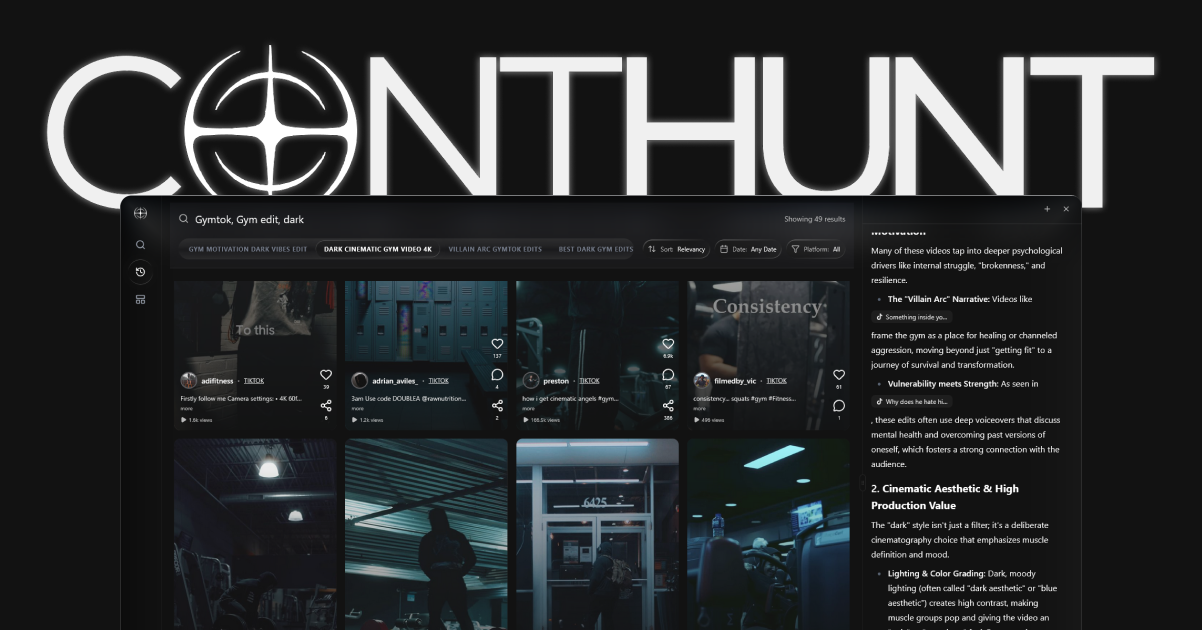
In the early days of social media, virality was a mystery. Today, it is a science. If you are waiting for “luck” to strike your channel in 2026, you are losing to the creators who are using Content Intelligence to engineer their success.
1. The “Vibration” Metric
In 2026, the Facebook, TikTok, and YouTube algorithms all use a variation of the Vibration Score. This score measures:
- Instant Hook (0.0 - 0.5s): Does the user stop scrolling immediately?
- Emotional Resonance: Does the AI detect an emotional reaction (via comments or re-watches)?
- Social Velocity: How fast is the video being shared outside the platform?
2. The Audience Retention Paradox
The biggest mistake creators make in 2026 is trying to please everyone.
- The Paradox: High retention with a broad audience is impossible in the first 24 hours.
- The Strategy: Aim for 90% retention with a niche interest node first. Once you win that node, the algorithm handles the broad expansion for you.
- Benchmarking with ContHunt: Use our Retention Blueprint to see where the average user in your niche drops off. If your drop-off is 2 seconds later than your competitors, you are on path to go viral.
3. The Power of “Cultural Hooks”
Virality in 2026 is often tied to ‘Contextual Glue’. This means linking your video to an existing cultural conversation or a high-velocity audio track.
- Trend Harvesting: ContHunt identifies these “Hooks” in real-time. We show you which visual styles (e.g., ‘Lo-Fi Grit’ vs ‘Cinematic Polish’) are currently triggering the viral algorithm in your specific industry.
- Interest Overlap: Discover which other topics your viral audience is watching. If #travel lovers are suddenly watching #cooking, that is your bridge to a massive new audience.
4. Engineering the Share
Likes are cheap. Shares are premium. To go viral in 2026, your video must be “Saveable” or “Sendable.”
- Utility Virality: “I need to remember this” (Saves).
- Relatability Virality: “This is so us” (Shares).
- Aesthetic Virality: “This looks incredible” (Re-watches).
2026 Viral Engineering Checklist
- [ ] Does the first 0.5 seconds contain a visual disruption?
- [ ] Is there a ‘Payoff’ every 7 seconds to maintain tension?
- [ ] Have I verified my ‘Node Alignment’ in ContHunt to ensure I hit the right Seed Audience?
- [ ] Is the call-to-action focused on Sharing or Saving rather than Follow/Like?
Conclusion
Virality is no longer a bolt of lightning; it is a fire you build with the right wood and the right sparks. By understanding the 2026 Vibration Score and using ContHunt to benchmark your retention against the platform’s best, you can turn your creative efforts into a predictable viral engine. Stop hoping, and start engineering.
How should you apply What Makes a Video Go Viral? The 2026 Algorithmic Formula without copying one viral post?
Start with a small sample of public posts in the same niche and format, then compare them side by side. ContHunt is useful here because it keeps the original source available, so you can inspect the first seconds, overlays, comments, and publishing context instead of ranking ideas by total views alone. Capture the promise, the proof, and the next step the creator asks for. After you draft your version, change only one variable at a time: hook, length, caption, or thumbnail. That is the founder-led research loop we use internally at Synthenova Enterprises LLP: evidence first, then a test you can actually measure.
What should you write down while reviewing examples?
-
- The “Vibration” Metric
-
- The Audience Retention Paradox
-
- The Power of “Cultural Hooks”
-
- Engineering the Share
- 2026 Viral Engineering Checklist
- Conclusion
- Original URL and publish date
- Audience and offer, if one is stated
- What you will test next on your own account
Which ContHunt workflow matches this page?
- Search public short-form videos for the same viewer problem.
- Open several examples and keep the source links.
- Compare hooks, pacing, text, and comments.
- Turn repeating patterns into a brief, not a clone.
- Validate with your own retention and reply data.
Which official docs should you verify against?
How do you keep the brief honest?
Write the date you collected examples and the number of posts you actually opened. If you only watched two videos, do not describe a trend. Note what you could not see: private analytics, paid spend, and anything behind a login. ContHunt does not replace YouTube Analytics, Instagram Insights, or TikTok Analytics on your own account. It helps you inspect public creative with the source still attached. When you publish, keep a short log: hook used, length, caption, and the result after a comparable window. That log is more useful than copying a competitor’s posting time.
If the page you are briefing is about What Makes a Video Go Viral? The 2026 Algorithmic Formula, ask whether the viewer already knows the punchline. If they do, the first seconds have to show a new proof, a tighter demo, or a clearer next step. If they do not, the first seconds have to name the problem in plain language. Either way, the caption should match the video so a muted viewer and a later reader get the same promise. That is the standard we use in editorial review at ContHunt, and it is the standard we recommend to agencies handing briefs between researchers and editors.
What questions should you answer before you shoot?
Does this idea match the audience you can actually reach? Can you film the proof you described? Is there a next step that is honest? If the answer is no, pick a smaller version of the idea. Then review two more public examples and only then schedule production.
Related research
- Multi-Platform Analytics Strategy: The 2026 Omnichannel Guide
- Metricool Pricing and Alternatives: The 2026 Comparison Guide
- Instagram Reels vs. YouTube Shorts Analytics: The 2026 Comparison
- Instagram Reels Strategy for Fitness Creators in 2026
Key data
- Viral Probability Floor
- 75% Retention — The minimum retention rate required in the first 5 seconds to even attempt a mass-market viral breakthrough in 2026.
- Share Multiplier
- 10x Reach — The exponential increase in reach for every 100 direct shares compared to 1,000 algorithmic likes in the 2026 feed.