Competitor analysis is not one task. A domain that competes with you in Google may not be the creator winning attention on Reels, and a social reporting suite may not explain which hook or format is spreading across short-form platforms.
This guide separates the tools by the evidence they provide. Features and plan limits change, so confirm the current vendor documentation before buying.
1. Choose the data you actually need
| Research question | Best starting category | Examples |
|---|---|---|
| Which sites compete for the same queries? | Search and SEO research | Semrush, SpyFu, SE Ranking |
| How large is a competitor’s web audience? | Traffic-estimation tools | Similarweb |
| How do competitor social accounts compare? | Social benchmarking suites | Socialinsider, Rival IQ, Sprout Social |
| What is being published and promoted? | Publishing, listening, and ad research | Hootsuite, Brandwatch, Meta Ad Library |
| Which public short-form videos and patterns are winning? | Content intelligence | ContHunt |
| What topics interest a competitor’s audience? | Audience research | SparkToro |
| Which stories already earned attention or links? | Content research | BuzzSumo |
2. The 15-tool shortlist
| Tool | Best fit | Important limitation to check |
|---|---|---|
| ContHunt | Public short-form discovery and AI-assisted analysis | It complements, rather than replaces, private account analytics |
| Semrush | Search competitors, keyword overlap, and paid-search research | Search visibility is not the same as social competition |
| SpyFu | Competitor keyword and advertising research | Coverage centers on search data |
| SE Ranking | SEO and PPC competitor research | Confirm database and location coverage for your market |
| Similarweb | Estimated traffic sources and channel mix | Traffic figures are modeled estimates, not a competitor’s analytics account |
| Socialinsider | Social benchmarking and client reporting | Verify supported networks and profile limits |
| Rival IQ | Cross-network competitive scorecards | Best suited to defined competitor sets |
| Sprout Social | Team reporting, listening, and governance | Broader suite may exceed a creator’s needs |
| Hootsuite | Publishing plus social listening and competitive workflows | Some research capabilities depend on the selected product or plan |
| Metricool | Scheduling and reporting for smaller teams | Distinguish owned-account analytics from public competitor data |
| Buffer | Lightweight publishing and account analytics | Not a full website or market-intelligence suite |
| Brandwatch | Enterprise social listening | Requires a larger implementation than a focused creator workflow |
| SparkToro | Audience sources, affinities, and research | It does not provide private competitor conversion data |
| BuzzSumo | Content, mentions, and link-earning research | Strongest for published content rather than private social metrics |
| vidIQ | YouTube channel and topic research | YouTube-specific rather than cross-platform |
3. Where ContHunt fits
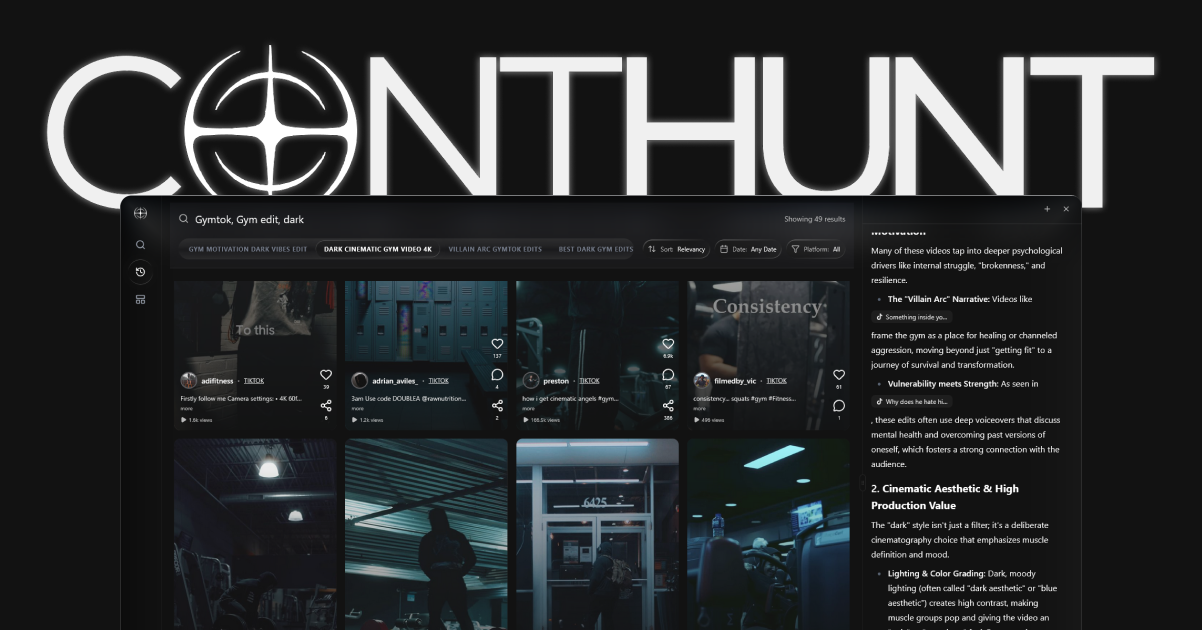
ContHunt is a public short-form content research layer. Its landing page documents searches across TikTok, Instagram Reels, and YouTube Shorts, plus AI analysis of hooks, pacing, overlays, and other visible creative patterns.
That makes it useful when your question is:
- Which public videos are outperforming in a niche?
- Which opening hooks, topics, captions, or visual patterns recur?
- Does a pattern appear on one platform or across several?
- Which examples should a team save to a research board?
It does not expose a competitor’s private retention graph, conversion data, or account dashboard. Use native analytics for accounts you own.
4. What the current SERP rewards
On August 26, 2026, we checked first-page results for competitor analysis tool, competitor finder tool, and how to find competitor websites. Rankings vary by time and location, but the sample showed a consistent split:
- Product and tool pages dominated the commercial queries.
- Search-focused products such as Semrush, SpyFu, Similarweb, and SE Ranking appeared repeatedly.
- Social-specific tools appeared when the query narrowed toward social competitor analysis.
- Step-by-step guides ranked beside tools for the informational query.
The practical SXO lesson is simple: a useful comparison page must identify the data category first, then help the reader pick a tool. A generic list of brand names does not resolve the intent.
5. A repeatable competitor-research workflow
Step 1: Build three competitor sets
Create separate lists for:
- Business competitors selling a similar product.
- Search competitors ranking for the same high-value queries.
- Content competitors earning attention from the audience you want.
One company can appear in all three lists, but do not assume it will.
Step 2: Record only observable facts
For each competitor, capture the URL or profile, date checked, recurring topics, formats, publishing cadence, and visible engagement. Label modeled traffic and third-party estimates clearly.
Step 3: Compare patterns, not isolated winners
A single viral post may be an outlier. Review a useful sample and ask whether the same hook, format, topic, or posting rhythm succeeds repeatedly.
Step 4: Turn the gap into a test
Do not copy a competitor’s post. Translate the evidence into a testable hypothesis: a clearer opening promise, a missing comparison, a better example, or a format your audience has not seen from you.
6. Free competitor analysis
A manual stack can answer many early questions:
- Search your priority queries and record recurring domains.
- Review public social profiles and platform search results.
- Use Google Trends to compare topic direction.
- Check Meta’s Ad Library for active advertising.
- Review public comments for repeated questions and objections.
- Save examples with the date, source URL, and reason they matter.
Paid software becomes valuable when the collection, history, alerts, exports, or client reporting would otherwise consume more time than the subscription saves.
7. Questions to ask in a vendor demo
- Is the data first-party, licensed, public, or modeled?
- Which countries, languages, platforms, and content types are covered?
- How often does each dataset update?
- Can we inspect the source behind an insight?
- Are exports and historical data included in the quoted plan?
- What cannot the product measure?
Conclusion
The best competitor analysis stack usually combines more than one evidence source. Use search tools for query and website competition, social suites for reporting, native analytics for accounts you own, and ContHunt for public short-form content discovery and creative-pattern research.
Related guides
- Competitor Analysis
- Instagram Competitor Analysis Tools
- How to Track YouTube Shorts Competitors
- What Is Content Intelligence?
Sources
- Competitor Finder · Semrush
- Competitive Analysis · Similarweb
- Competitive Analysis for Social Media · Hootsuite
- Instagram analytics · Socialinsider