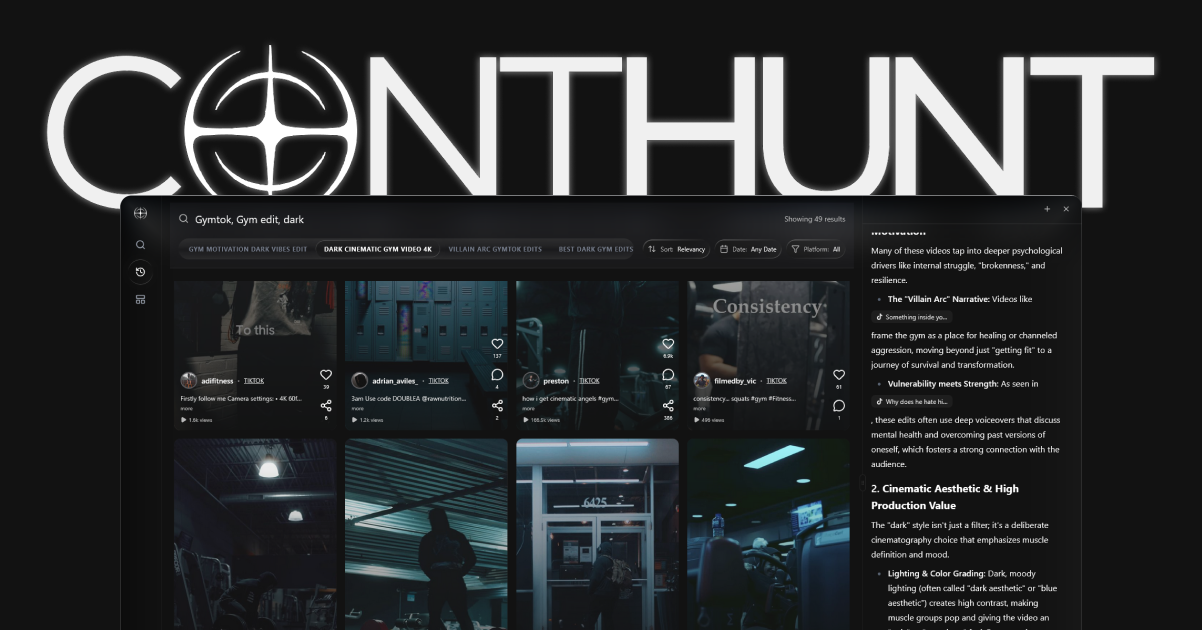
Creative block is a symptom of poor data. In 2026, you shouldn’t be staring at a blank screen; you should be staring at a Velocity Heatmap. This comprehensive guide covers everything you need to generate a content calendar that converts.
Part 1: The Fractal Ideation Method
Move from broad to hyper-specific.
The Workflow
Start with a broad node (e.g., #productivity). Use ContHunt to find the ‘Fractals’—#notion-for-architects, #deep-work-for-parents, #adhd-coding-hacks.
The Advantage
The more specific you are, the easier it is for the 2026 AI to find your ‘Perfect Seed Audience.’ Higher initial engagement and a faster global push.
Part 2: Using Interest Nodes as Your Muse
Listen to the machine.
The Strategy
Set up ContHunt alerts for ‘Emerging Nodes’ in your industry. When a new term begins to trend, your idea list should be 10 videos deep within the hour.
The Pro Move
Create a ‘Definition Series’ for new terms to establish yourself as the ‘Node Authority’ early in the trend lifecycle.
Part 3: The Visual Hook First Strategy
In 2026, the image precedes the idea.
The Concept
Start with a visual that stops the scroll (e.g., a 3D hologram transition). Then, build the content around why that visual is relevant.
ContHunt Integration
Track which visual styles are currently ‘High-Retention’ in your niche and build your ideas specifically to showcase those assets.
Part 4: The Content Idea Generator Strategy
Moving Beyond “The Keyword”
Keywords are for Google; Nodes are for People.
The Velocity-First Filtering
Only film what has a tailwind:
- Feed 100 raw ideas into ContHunt Benchmark
- Eliminate ideas targeting ‘Stagnant Nodes’ (zero growth in 48 hours)
- Choose ‘Breakout Nodes’ where interest is up 50% but competition is under the Red Zone threshold
Part 5: AI Content Generation
The Data-Led Generation Workflow
- Start in ContHunt - Identify the trending #visual-narrative node
- Feed the performance data into your generator (Claude, GPT, or Sora)
- Result: Content mathematically more likely to go viral
Multi-Modal Mastery
- Scripting: High-Hook scripts based on 2026 retention patterns
- Visuals: Generative video models for 4K B-roll
- Voice: Neural Cloning for consistent voiceovers
The Human-in-the-Loop Quality Standard
AI generates the 80%, you provide the 20%. Always verify AI claims, edit for brand voice, and add unique pinned comments.
Part 6: 50+ Proven Content Ideas for 2026
Educational Deep-Dive Category
- The “3-Second Fix”: Show a common mistake and fix it instantly
- The “Industry Mythbuster”: Debunk a popular but wrong belief in your niche
- The “Tool Stack Reveal”: Show the 3 apps you use to achieve a result
- The “Glossary Series”: Define complex terms in 15 seconds
- The “Time-Lapse Transformation”: Show a 10-hour process in 20 seconds
Relatable & Behind-the-Scenes Category
- The “Day in the Life” (Unfiltered): Show the boring parts, not just highlights
- The “Mistake Reflection”: Share a failure and what the audience can learn
- The “Client Q&A”: Answer a real question from your community
- The “Workspace Tour”: People love seeing where the magic happens
- The “Decision Logic”: Explain why you chose a specific strategy
Interactive & Participatory Category
- The “Pick My Next [X]”: Let followers vote on your next video topic
- The “Green Screen Reaction”: React to a trending industry news story
- The “Challenge Invitation”: Create a simple 7-day habit challenge
- The “Fill in the Blank”: A prompt for the comments section
- The “Live Audit”: Briefly audit a follower’s profile or content
High-Growth Idea Templates
- The “Data Reveal”: “I analyzed 1,000 [Niche] videos and found THIS…”
- The “Node Crossover”: “Why [Industry A] is terrified of [Industry B] in 2026”
- The “Expert Critique”: “A 2026 [Job Title] reacts to the #1 viral trend”
- The “Silent Tutorial”: 15 seconds of pure visual steps with high-energy audio
- The “Tool Benchmark”: “Is [Popular Tool] actually 2.4x faster? Let’s check the data”
- The “Zero-to-One” Journey: “How I dominated the #new-node in 7 days”
- The “Future Forecast”: “Why the 2026 interest graph is moving toward [Topic]”
- The “Information Gap”: “The one thing every creator missed about [Trending Event]”
Part 7: Social Media Post Ideas
The “Interactive Intel” Post
- The ‘A/B Test’ Carousel: Show two versions and ask which solves the problem better
- The Binary Poll: “Do you prefer [Tool A] or [Tool B] for 2026?”
- The Knowledge Gap: “Most people think X, but the data says Y. Thoughts?”
The “Raw Reality” Post
- The Unedited Screenshot: Share a screen recording of your actual workflow
- The ‘Voice Memo’ Video: A static image with high-value audio
- The Real-Time Audit: “I’m auditing my 2026 budget live—here are 3 subscriptions I’m canceling”
The “Community Spotlight”
- The ‘Hero’ Feature: Share a follower’s success story
- The Crowd-Sourced Guide: “Comment your #1 tip, we’ll turn best 10 into a guide”
- The AMA: Host weekly threads for niche-technical questions
Part 8: The Golden Ratio for 2026
The 70-20-10 rule:
- 70% Educational/Value content
- 20% Personal/Brand Storytelling
- 10% Direct Sales or Promotion
2026 Ideation Strategy Checklist
- [ ] Have I validated my top 5 ideas in the ContHunt Velocity Map?
- [ ] Is each idea targeting a specific ‘Fractal’ sub-niche?
- [ ] Do I have a ‘Visual Hook’ designed for the first 1.5 seconds?
- [ ] Am I taking a proven ‘Node Pattern’ and applying it to my unique voice?
- [ ] Have I validated the target ‘Node’ in ContHunt before generating?
- [ ] Does the idea have a ‘Visual Anchor’?
- [ ] Is this a ‘Fresh Fractal’ or a ‘Saturated Topic’?
Conclusion
The 2026 creator is an Idea Architect and System Designer. By using algorithmic data to build the foundation of your content, you free your mind to focus on storytelling and visual excellence. Use ContHunt to fuel your creativity, and let your ideas find their home in the feed.
Key data
- Viral Conversion Rate
- 3.5x — The average increase in viral probability for ideas validated through ContHunt velocity data vs. 'gut-feeling' ideation.
- Hook Efficiency
- +75% — The increase in 3-second retention rates for videos generated from ContHunt's 'Velocity Nodes' vs. manual brainstorming.
- Production Volume
- 5x Increase — The typical growth in content output for creators who switch from manual search to automated ideation.
- Engagement Multiplier
- 3.5x — The performance lift for 'Shared Experience' content compared to traditional corporate updates.
- Retention Premium
- 45% — The increase in average watch time for videos that use a 'Question-Based Hook' compared to 'Statement Hooks'.